Your agents keep repeating the same mistake.
Vectadyne remembers so they don't.
The enterprise hive mind for engineering agents — a governed memory control plane beneath the coding, review, and deploy agents you already run. What one agent learns, the whole fleet inherits: validated, typed, and governed by who may see, trust, and act on it.
 preflight.action
One shared brain for every agent in your org.
Every trace, review, and failure from every agent flows into a single governed graph — typed, scoped, and versioned. What one agent learns, the whole fleet inherits, without ever leaking across the boundaries you set.
Single-tool memory can't govern.
Claude Code, Cursor, and Copilot each remember inside their own vendor's tooling. None can share evidence, enforce deterministically, or produce an exportable audit trail — and never across another vendor's agents.
Agents reintroduce the same bad change nobody wrote down, because the lesson lived in a chat that scrolled away.
Every agent, repo, and vendor keeps its own island of context. Review wisdom never crosses the boundary where it's needed.
When an agent acts, there's no tamper-evident record of what it knew, what it was allowed to do, or why the call went through.
One deterministic pipeline, evidence to audit.
Raw agent activity becomes governed, explainable memory in five stages — every step traceable back to immutable evidence.
Two capabilities single-tool memory can't touch.
The whole memory fabric, at a glance.
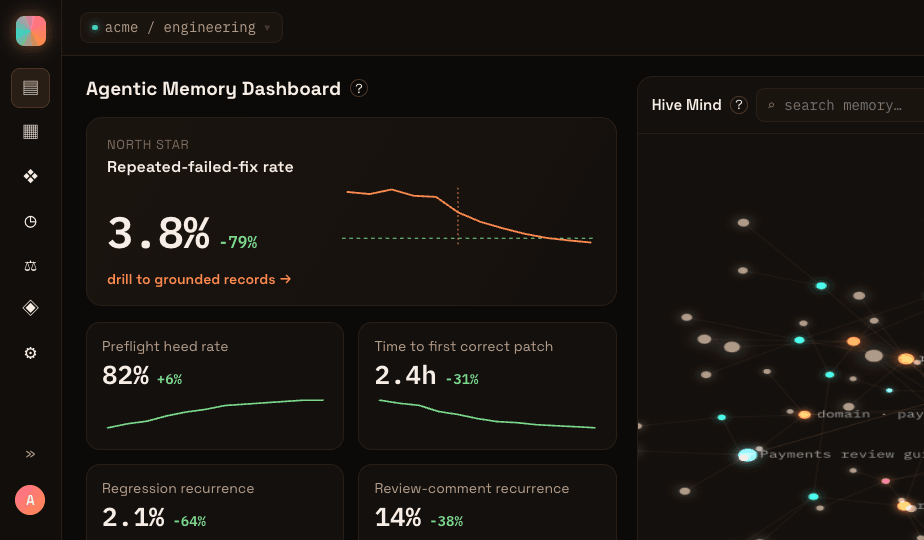
Operators watch the hive mind from one dashboard: the north-star failure-prevention metric, live memory graph, and a drill-path from any number straight to the grounded records behind it.
Every memory is a point in three dimensions.
Scope, time, and abstraction are orthogonal axes — surfaced explicitly in the console so you always know who a memory is for, when it's true, and what shape of knowledge it is.
A scope-key lattice inherits governance from org down to a single tool.
repo › env › role › agent › tool
Bi-temporal validity plus a lifecycle, so stale knowledge forgets itself on event.
Seven typed kinds, each color-coded across every view.
One surface. Three interfaces. Every agent.
All business logic lives in one service, exposed identically over MCP, REST, and the vec CLI. Ingest from agent traces and GitHub — PRs, reviews, and CI checks.
Governed by design, not by policy you have to write.
v1 ships with zero hand-authored policy — value comes from auto-derived lessons — while every decision stays explainable and exportable.
Append-only, hash-chained system of truth — tamper-evident by construction.
Returns allow / warn + cited provenance; blocking is opt-in per high-risk action.
Memnos answers cite memory IDs and evidence — never free-form.
Full tenant isolation from day one, with SOC 2-relevant audit export.
Start free. Govern when it matters.
For a single engineer wiring up governed memory.
Start freeFor teams governing a fleet of agents across repos.
Book a demoFor orgs with compliance and scale requirements.
Contact salesQuestions, answered.
Neither. It is the governed memory layer those tools sit on top of — neutral, shared, and governed across many agents and many backends. Your runtimes and vector stores stay exactly where they are.
Not by default. v1 is advisory-first: preflight returns allow or warn with cited provenance. Hard blocking and required-approval are opt-in per high-risk action class and enforced at the CI/PR adapter, never on the inline hot path.
No. v1 ships with zero hand-authored policy. Value comes from auto-derived failed-action lessons and distilled review wisdom — governance emerges from your evidence, not a rulebook you maintain.
One service exposed over MCP, REST, and the vec CLI, with ingest from agent traces and GitHub. That shared, cross-vendor boundary is precisely what single-tool native memory cannot reach.
Vectadyne
The governed agent-memory control plane for engineering teams running agents at scale.